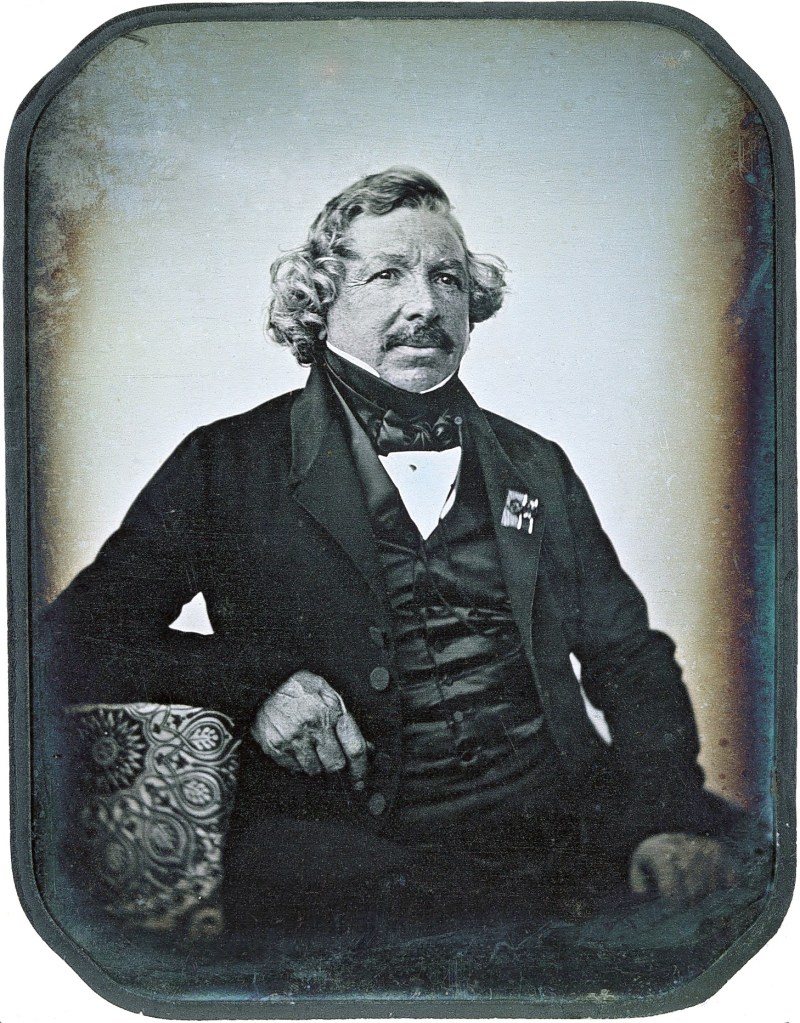
Image from Wikipedia.
The Daguerreotype
The history of photography is very long, and you could say that it started with the camera obscura. There have been significant discoveries along the way, that has paved the way for modern photography. One of the advancements on this path is the photographic process of daguerreotype.
What exactly is a daguerreotype? Daguerrotype or daguerrotypi was the first publicly available photographic process, popular from 1839 to 1860. It was invented by Louis Jacques Mandé Daguerre, a French artist and inventor of the theatric diorama.
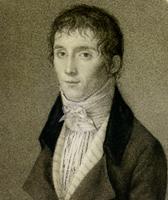
Daguerre was conducting similar research to the contemporary inventor Joseph Nicéphore Niépce, and they entered a partnership in 1829 to find a way create a permanent photography from the camera obscura. Together, they developed the physautotype, a process that used lavender oil distillate as the photosensitive substance. Their partnership ended when Niépce died in 1833, but Daguerre continued to experiment, eventually working out a different process that only superficially resembled Niépce’s. He named this process the daguerreotype, after himself.
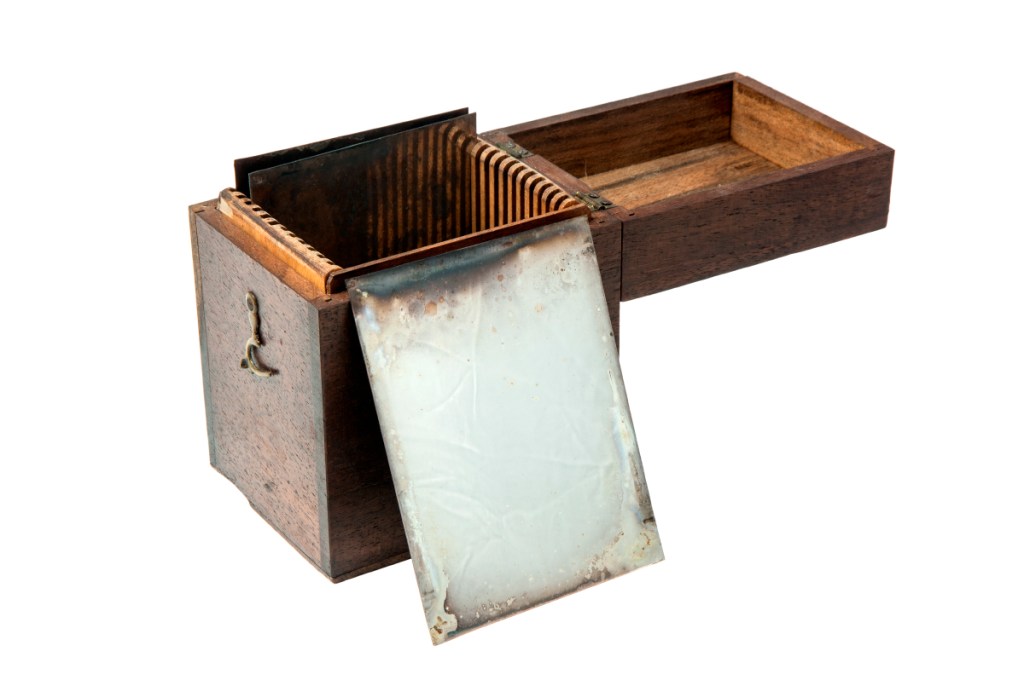
Image from Wetplatewagon.
To create a daguerreotype a sheet of silver-plated copper was polished to a mirror-like surface, then treated with fumes that made its surface light sensitive. It was then exposed in a camera for as long as necessary, which could be as little as a few seconds for brightly sunlit subjects or longer with less intense lighting The latent image was then made visible by fuming it with mercury vapor. Its sensitivity to light was removed by giving it a liquid chemical treatment, rinsed and dried. Since the metal plate is extremely vulnerable, highly reflective, and only possible to be viewed from a specific angle, most daguerreotypes are presented in a special housing. The main advantage that daguerreotype had over previous attempts of photography, was that it was highly detailed, accurate, sharp and permanent.

Image from Photography History Facts.
The process of making the daguerreotype was quite straight-forward, and Daguerre had written and distributed an instruction manual to explain how it worked. Up until then portraits had to be painted by an artist, but by giving the public access to the daguerreotype, the costs of making a portrait was made significantly lower. The process of making a portrait could however be quite difficult, as the subject had to stay entirely still for 5-8 minutes, the time it took to expose the plate. They worked around this problem by using “techniques” like head clamps, limited poses or opioids. Because the portrait painters faced this competition, many of them became daguerreotypes (photographers), and advanced the craft by applying their fine art skills.
The patent rights were bought by Richard Beard in 1840, then he hired John Frederick Goddard who found a way to increase the sensitivity of the copper plate used in the daguerreotype process, by adding bromide. At the same time Hippolyte Louis Fizeau used a technique called guilding, which minimized oxidation of the plate, and improved the contrast of the image. In America silversmiths began to commercially produce plates with more silver and more polish, which then spread the daguerreotype over the world.
The advancements in photography came faster than they ever had come before, from this point, and it’s pretty clear that the without the daguerreotype, photography wouldn’t have come as far as it has today.
 My Reflective Journal
Leave a comment