Using the SCAMPER method
For the third and final part of this week’s Learning Activity, I will use the SCAMPER method to change two existing items into something different.
The Teaspoon
Substitute:
I would substitute the steel with durable biodegradable plastic, which is important to a lot of environmentally conscious parents. If possible, spoons will have different colors, matching the smoothie/porridge bags.
Combine:
The spoon will be part of a series of new smoothie- and porridge squeeze bag products targeted to parents of kids, aged 6-18 months old. It will be wrapped in clear biodegradable plastic and glued onto the smoothie, just like some yogurts come with a fold-able spoon.
Adapt:
I will adapt the plastic straw, which will serve as the spoon handle, which then screws onto the smoothie/porridge bag. You may then squeeze the smoothie/porridge into the spoon, through the handle.
Modify:
I would emphasize the convenience of having a spoon that refills with smoothie. Using your own spoon, which you then squeeze the smoothie into usually get very messy in stressful situations. This new product combination will appeal to parents (or uncles/aunts etc.) on the go. (As a father of two, I know I would have loved to see this!)
Put to Another Use:
Instead of being used for stirring sugar in tea, the new teaspoon will be used as a tool in a series of smoothie and porridge squeeze bags, targeted to parents and their babies (6-18 months old).
Eliminate:
The spoon handle will be shortened considerably, just long enough to screw onto the squeeze bags.
Rearrange:
Instead of scooping up smoothie/porridge, the spoon will refill by squeezing it.
Final product: Spoon for a series of smoothie/porridge squeeze bags
The teaspoon has change from a tea-stirring tool into a spoon for a series of smoothie and porridge squeeze bags.
The spoon itself will be biodegradable, and the color will reflect the smoothie/porridge product color (example: red spoon for red bag, with strawberry-banana smoothie). You remove the cap from the smoothie/porridge and screw the spoon onto the opening. The spoon handle has been shortened and made into a tube, which allows the customer to squeeze the smoothie or porridge into the spoon.
This product will appeal to a lot of parents, babysitters etc. on the go, because you don’t have to remember to bring a spoon, and filling the spoon will be a lot less messy.
Design packaging for rice
Substitute:
The big cardboard packaging will be substituted for something smaller, and contain only two portions instead of a huge amount of rice.
The various spices (mentioned under) will inspire experimentation, instead of just being used as a regular side-dish.
Combine:
While the assignment is about redesigning the rice packaging, I would like to add a new idea: rice spices. One end will open up to the rice, while the other has a small room for the spices.
Adapt:
The packaging will look similar to the big tubes of Smarties, cut in two, widened, and will be adapted to contain rice instead.
The view of rice as a side-dish will be challenged, as the new packaging will offer rice spices, with 3-5 options to choose from.
Modify:
Instead of a box, the rice packaging will be shaped like a tube, with lids in both ends that you can rip off. The tube will be made from recycled paper, which along with less rice, will minimize the environmental footprint.
The tube will be minimized to only hold two portions of rice, while emphasizing the added spices, and inspiring to experiment with the different spice options available.
The different spice options will be easily distinguishable by having each tube in a different dominating color
Put to Another Use:
This new rice packaging, with spices, can be marketed as the new hip thing, being used either as a side dish, or as a quick lunch.
Eliminate:
I would tone down the size of the tube, to only fit the spices and the rice.
Instead of only being used as a side-dish, this will also serve as a quick lunch. This, along with the spices, will be one of the main selling points.
Rearrange:
The rice and spices can be mixed together instead of having a separate compartment for spices.
Also offer an option to only have plain rice, with no spices.
Instead of spices, it could contain a sauce, but it could prove a lot of problems during transportation, if the tube is broken.
Having a complete meal, by adding dried pieces of soy or lentils in the spice mix.
The final rice packaging
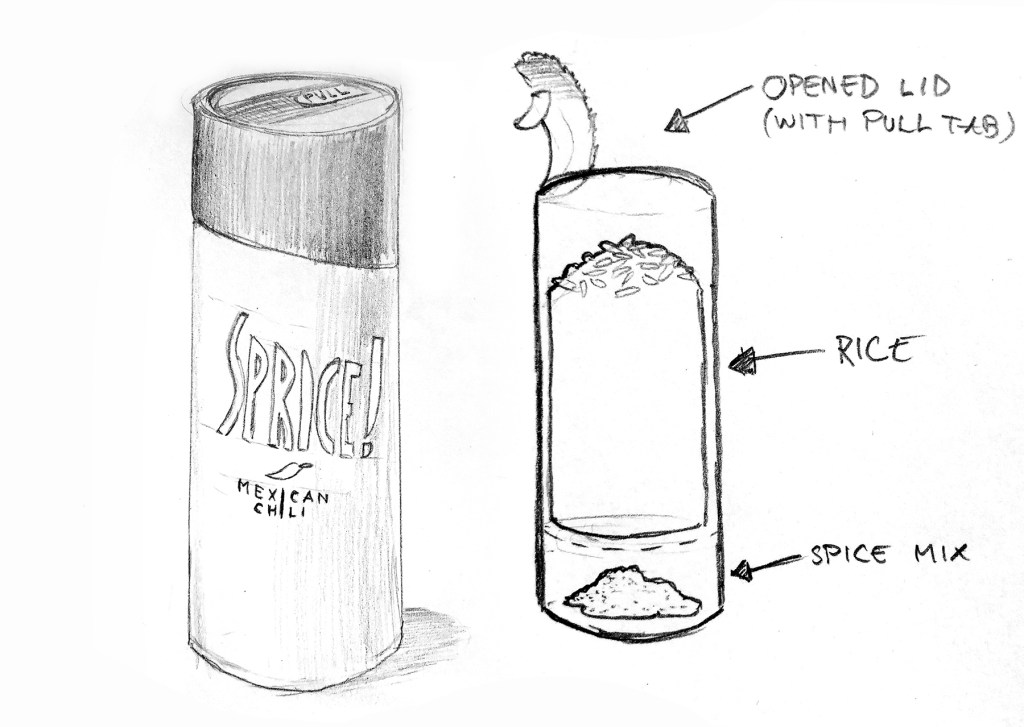
In the process of redesigning the rice packaging it escalated into making a new use of the product: rice with spices. Instead of a big plastic bag or a rectangular box, the rice packaging is now a tube. This tube has two compartments: one for the two portions of rice, and one for a spice mix. The compartments can be opened by pulling the tab of a cardboard lid.
While this packaging design is centered around a series of 3-5 spice mixes, it will also offer a plain option, with no spices.
In the future this product can be expanded to contain a complete lunch, with dried pieces of soy or lentils.
The packaging will be color coded with bold colors, to make the various spice mix options easily distinguishable on the store shelf.
The new range of rice/spice mix options will be marketed as a way to experiment with rice as a side-dish, and also as a simple snack or lunch.
Here is my sketch of the rice packaging, with the incredibly cheesy name: Sprice (spice + rice)
 My Reflective Journal
Leave a comment